This lesson will focus on the conjugation of the verb “être” (to be). We will also start making simple sentences.
Since conjugation is a bit more complex in French than in English, we will need to learn the subject pronouns in order to start conjugating verbs.
Singular
1st person
je
I
2nd person
tu
you
3rd person
il
he / it
elle
she / it
on
we / one / people
Plural
1st person
nous
we
2nd person
vous
you (plural, or polite “you”)
3rd person
ils
they (masculine)
elles
they (feminine)
There are two ways to translate the English “you” in French:
“TU” = singular “you”. “TU” is used for a person you are in first name basis with, like talking to children, friends, etc.
“VOUS” is the “you” courtesy that you will need to use in all other situations. “VOUS” is also the plural of “you” when talking to more than one person.
Conjugation of the verb “être” (to be)
être
to be
je suis
I am
tu es
you are
il/elle/on est
he/she is (or we are)
nous sommes
we are
vous êtes
you are
ils/elles sont
they are
Be careful, spoken French could sound a little different to written French due to the “liaisons”, which are very common. A “liaison” consist of linking a silent consonant at the end of a word to the beginning of the next word when the next word starts with a vowel or a silent H. Some “liaisons” are mandatory, some others could be optional.
It is very important to learn French speaking with the “liaisons.” Otherwise, it will be very hard for you to understand a native French speaker.
For the table of conjugation of the verb “to be”, you will need to make the liaisons for the following sentences:
il est -> to make the “liaison,” you will link the end of the first word to the beginning of the next one. So “il est” is pronounced [ilé]
elle est -> same thing here. The “e” at the end of “elle” is silent, so we make the link between the “l” and the “est”. So “elle est” is pronounced [èlé]
on est -> the “liaison” here is more than mandatory, as you will almost never ever hear someone pronounce the 2 words separately. So “on est” needs to be pronounced [ɔ̃né].
vous êtes -> this “liaison” is also a must to know, as you will never hear a native French speaker pronounce these words separately. Since there are vowels between the “s” (at the end of “vous”), you will need to pronounced the “s” as a [z]. So “vous êtes” needs to be pronounced [vu zɛt].
Contrary to English, French nouns have a gender that affect the articles you use with them. They are either of masculine or feminine gender. The gender of the noun will be learned along with the vocabulary as there are no reliable rules to determine gender in advance (except examples where gender is obvious like ‘woman’, ‘man’, ‘boy’ etc.). Nouns of masculine gender:
un garçon (a boy)
un enfant (a child)
Be careful, spoken French could sound a little different to written French due to the “liaisons”, which are very common. Here, “un enfant” is pronounced by linking the last letter of the article “uN“ to the beginning fo the next word “ENfant” -> so it needs to be pronounced “un nenfant” More on the “liaisons” in our first lesson.
2. French Pronunciation
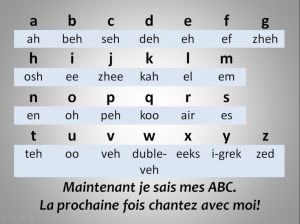
Much like English, French pronunciation can sometimes be a little tricky, especially for a new learner. There are rules regarding pronunciation, but there are also a lot of exceptions and many examples of words with silent letters. But don’t worry, we will learn it all step by step. In the videos below you learn the alphabet and the majority of sound combinations in the French language. First, in the video below, you will find the pronunciation of the alphabet, syllables and some vocabulary.
Please watch our video below:
Explanations following the video
The letters C and Ç
When “c” is followed by the vowels “a”, “o”, or “u”, the letter “c” is pronounced [k]
une carotte(a carrot)
un coq (a rooster/cock)
une culotte(panties/underpants)
To make the sound [s] with these vowels you will need to add a cedilla.
ça (this, it, that)
un garçon (a boy)
un reçu (a receipt)
When “c” is followed by the vowels “e”, “i”, or “y”, the letter “c” is pronounced [s]
une cerise (a cherry)
une citrouille(a pumpkin)
un cygne (a swan)
The letter G
When “g” is followed by the vowels “a”,”o”, or “u”, the letter “g” is pronounced [g]
une gare (a (railway) station)
un gorille (a gorilla)
Gustave
When “g” is followed by the vowels “e”,”i”, or “y”, the letter “g” is pronounced [ʒ]
une cage(a cage)
une girafe(a giraffe)
un gymnaste (a gymnast)
In order to get the sound [g] with these vowels you will need to add a “u”. examples: une guerre, une guitare, Tanguy. When the letter “g” is followed by the consonant “n”, we get the sound [ɲ]. example: un agneau (a lamb)
The letter H
Unlike in English, the letter “h” at the beginning of a word is usually silent in French. Examples: un hibou, un hérisson, etc.
The letter S
When “s” is between two vowels in a word, the letter “s” is pronounced [z]. Example: une cerise, une musique When you have “ss” between two vowels, the double “S” are pronounced [s]. Example: un assistant, une assurance
The letter W Words with “w” are mainly borrowed words and are generally pronounced like in its language of origin. The letter “w” is not a common letter and has two pronunciations, either [v] (German words) or [w] (English words). Examples:
[v] -> un wagon ; Wolfgang
[w] -> watts, walkman
Here is our ABC Song in French:
3. French Conjugation
The conjugation of a verb varies depending on the following points:
the person perspective (i.e. 1st person, 2nd, 3rd, etc. depending on the subject of the verb. for example: I, you, we, they, etc…)
the tense (for ex.: present or past)
the mood (for ex.: indicative or conditional)
the voice (active or passive)
French conjugation could seem a little complicated at first, but once you learn a few little tricks, it will become easier. There are 3 groups of verbs, which could be distinguished by the ending of the infinitive verb (a verb that is not conjugated).
The 1st group: infinitive verbs ending by -ER. This group of verbs are the easiest to conjugate, as the conjugation rules are simple and regular.
The 2nd group: infinitive verbs ending by -IR. This group of verbs are also easy to conjugate, the rules are regular and easy as well. But some of the 3rd group’s verbs can also end by -IR, so it will be important to distinguish them.
The 3rd group: infinitive verbs ending by -IR, -OIR, -RE. This group has around 350 verbs. Contrary to the first 2 groups, this one has irregular rules and exceptions regarding the conjugation.
This is your very first post. Click the Edit link to modify or delete it, or start a new post. If you like, use this post to tell readers why you started this blog and what you plan to do with it.





 THE MUSICIANS
